As mobile app feature iteration accelerates, memory resource conflicts caused by multiple applications concurrently in heavy usage scenarios are becoming increasingly prominent, easily causing app lag, background background cleaning, page overloads, crashes, and increased power consumption, directly affecting user experience. Establishing a public and predictable standardized memory management mechanism has become a key direction for the terminal industry to improve user experience. To address these issues, the CTTL Terminal Labs (CTTL-T) of China Academy of Information and Communications Technology (hereinafter referred to as "CAICT") , together with the BRICS Future Network Research Institute and major terminal industry enterprises, jointly issued an industry initiative in June 2026 to jointly promote the "fair operation of memory mechanisms" for smart devices. At the same time, the Telecommunication Terminal Industry Forum Association released the group standard T/TAF 358—2026 "Technical Requirements for Memory Management in Mobile Smart Terminals," which sets unified technical requirements for monitoring, prompting, releasing, and managing memory in mobile applications and operating systems, providing a technical basis for memory optimization for terminal manufacturers, operating system vendors, and application developers.
Recently, the CTTL-T of the CAICT awarded Vivo Mobile Communications Co., Ltd. the "Fair Operating Mechanism and Efficiency Evaluation Certificate for Smart Terminal Memory." The Fair Operating Memory Mechanism (ITGSA) equipped on vivo terminals has officially passed the full compliance test under T/TAF 358-2026 "Technical Requirements for Memory Management in Mobile Smart Terminals."
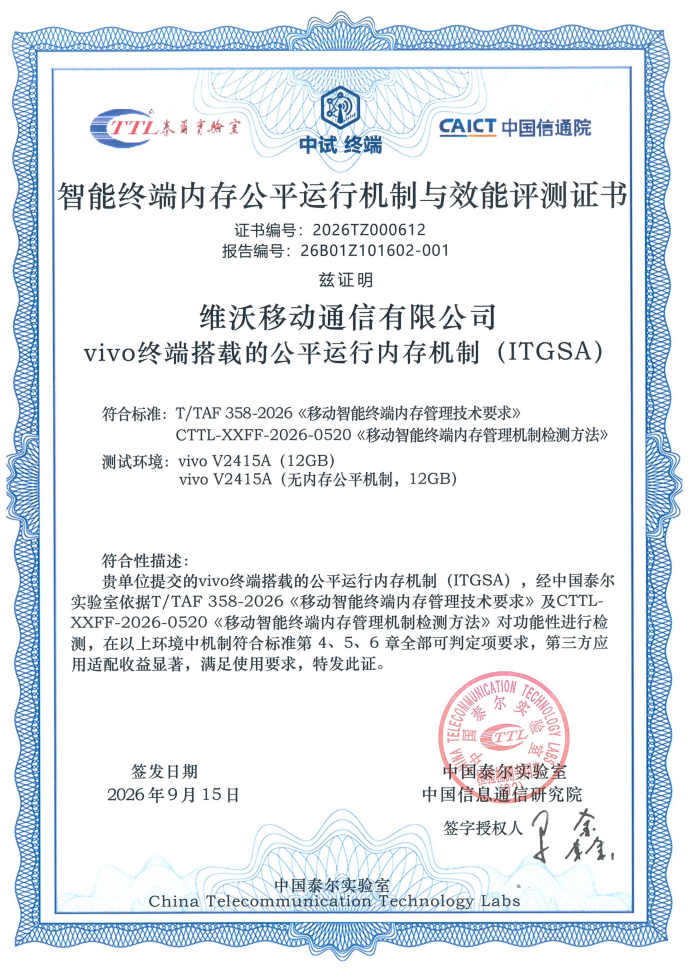
This evaluation was independently conducted by CTTL-T based on industry standards and supporting testing methods, selecting the vivo V2415A (12GB) model as the validation carrier. They built a dual control testing environment for both mechanisms and non-mechanisms on the same platform and system, combining self-developed automated testing tools with real-world application ballast. The test solution rigorously verified a total of 30 indicators from three dimensions: operating system standard compliance, third-party application adaptation benefits, and system-side scheduling fairness.
Test results show that all 30 tests of vivo's ITGSA fair operation memory mechanism meet the standards, fully meeting the standard's determinable requirements. Regarding third-party application adaptation benefits, after the application follows the standard and adaptation, the overall device resource allocation is reasonable. Even when relegated to the background in heavy usage scenarios, the device can survive and retain the usage site, with significant benefits in the number of background apps retained; Multiple rounds of repeated testing show a downward trend in overall device power consumption, processor temperature also decreases, and memory optimization provides stable and reproducible improvements in energy saving and temperature control. Additionally, in a mematic environment, both application smoothness and overall device smoothness are improved; The system can precisely clean up over-limit applications and perform on-site recovery, achieving a 100% success rate, effectively ensuring the front-end application experience.
This test was also conducted using a national-level information and communication pilot platform, providing specialized pilot services to connect the entire chain of memory management from "technology R&D, product validation, to industry implementation," helping terminal manufacturers, operating system manufacturers, chip companies, and application developers improve product quality and user experience. During testing, the CTTL-T provided vivo with full-process technical support, covering test scheme design, control environment setup, and multi-dimensional indicator verification, ensuring the rigor and traceability of evaluation results. The full approval of the ITGSA mechanism also provides a typical practical reference for the standardized implementation of terminal memory management technology in the industry.
As an authoritative domestic terminal technology evaluation organization, CTTL-T has a comprehensive technical system and self-developed toolchain in smart terminal performance evaluation and resource management standard verification. Next, CTTL-T will continue to follow the development trends of terminal memory management technology, improve relevant evaluation standards and testing capabilities, provide terminal manufacturers with professional technical evaluation and compliance support, support industry technological innovation, and promote high-quality development of the smart terminal industry.
Contact Person:
Mr. Duan
18611696093
Mr. Li
15810361176
Mr. Zhang
13426086035